Kluane Museum of Natural History
Kluane Museum of Natural History
A cultural stop on the Alaska Highway, the Kluane Museum of Natural History presents Yukon wildlife, Southern Tutchone culture, and regional mineralogy at Burwash Landing.
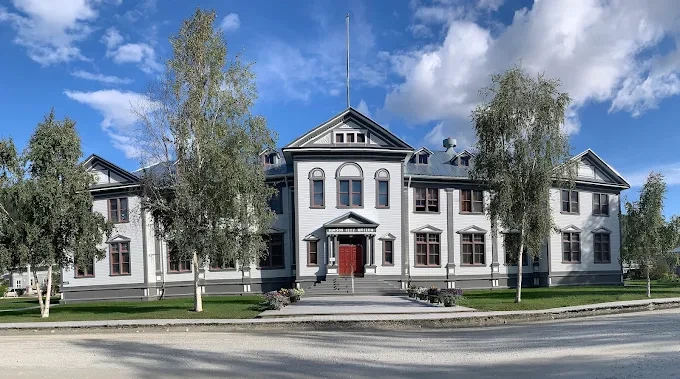
At Burwash Landing, along the Alaska Highway, the Kluane Museum of Natural History occupies a converted church turned museum. Organized around three themes — Yukon wildlife, Southern Tutchone culture, and regional mineralogy — it serves as an introduction to the territory before crossing Kluane National Park.
Why visit this museum
The museum complements the major institutions in Whitehorse: it connects the natural riches of Kluane National Park to the human history of southwestern Yukon, through the culture of the Kluane First Nation and the Southern Tutchone people. It's also one of the few cultural stops on this stretch of the Alaska Highway, between Haines Junction and the Alaska border.
Just steps from the building stands the World's Largest Gold Pan, a monumental gold pan that recalls the importance of the gold rush in regional history and serves as a well-known landmark for travelers.
Building history
The building housing the museum was originally designed as a church, conceived by Konrad Domes and his students from Yukon College in Whitehorse. Built in 1974 by the Kluane First Nation, the structure quickly proved too large for the small local Catholic community. Father Huijbers then proposed that the museum society take it over.
The first collections were housed in a neighboring old cabin. A forest fire in 1999 destroyed several buildings on the site, and the objects were transferred to the former church, which gradually became today's museum.
The collections
The tour is organized around three thematic sections, complemented by a shop and a screening room.
Yukon wildlife
Dioramas recreate the region's major habitats. Bears, caribou, elk, wolves, birds, and fish are staged in their respective environments, illustrating the biodiversity of southwestern Yukon.
Southern Tutchone culture
Clothing, tools, and weapons of the Southern Tutchone people testify to a way of life closely tied to the land and natural cycles. These pieces form the museum's cultural heart and its Indigenous foundation.
Minerals and geology
A collection of minerals and stones from the region — quartz, jade, and semi-precious stones — highlights the geological wealth of the Yukon's bedrock and the links between mining and the valley's settlement.
Screenings and shop
Regular video screenings about Yukon and Alaska extend your visit. The shop offers a selection of local crafts: decorated moccasins, jewelry, and publications on the North.
Practical information
The museum is located at Burwash Landing, along the Alaska Highway, at mile/km 1093. Allow approximately 1 to 1.5 hours for your visit. Admission is reasonably priced, with usual reductions for seniors, students, and groups; free entry for young children with adults. On-site facilities: parking suitable for large vehicles (RVs, motorcycles), free Wi-Fi, shop, and screening room.
When to visit
The museum is only open during the summer season, generally from May to mid-September, in line with tourist traffic on the Alaska Highway. Hours vary from season to season: it is recommended to check with the museum before departure. Outside this period, the building is closed and the region is difficult to access.
How to get there
Access is primarily by road. Burwash Landing is approximately 3 hours 15 minutes from Whitehorse and 2 hours 15 minutes from Beaver Creek, at the Alaska-Yukon border. Most visitors arrive by car, motorcycle, or RV, as part of an itinerary between Whitehorse and Alaska. No regular public transportation serves the village.
Nearby
The museum is a natural stop for travelers exploring Kluane National Park, whose trails and viewpoints spread to the south, around Haines Junction. The World's Largest Gold Pan, an immediate neighbor of the museum, complements your visit in a few minutes. To expand a broader Canada itinerary, you can venture to other heritage sites such as Historic Hat Creek in British Columbia, or urban destinations like the CN Tower in Toronto.
Frequently asked questions
Frequently asked questions
Allow 1 to 1.5 hours to explore the three collection sections, watch a video screening, and browse the shop. Add a few minutes for the World's Largest Gold Pan outside.
No. Opening is seasonal, generally from May to mid-September. Outside this period, the building is closed.
Photography is generally tolerated inside, without flash and outside temporary exhibitions. If in doubt, ask at the reception before photographing Indigenous pieces.
Yes. The parking area is through-traffic friendly and suitable for large vehicles, making it a convenient stop on the Alaska Highway.
Plan your trip
A stop at the Kluane Museum of Natural History naturally fits into a Yukon circuit or a journey to Alaska. To build a complete itinerary, explore our Canada travel ideas.
Interested in this visit?
We can include it in your personalised itinerary.