Mount Royal
Mount Royal
An urban massif dominating Montreal, Mount Royal brings together a landscaped park, viewpoints, an illuminated cross, the Saint-Joseph Oratory and remarkable biodiversity within a heritage-listed site.
Mount Royal forms the iconic hill that dominates Montreal. An urban massif covering roughly 10 km² with three summits, it combines a public park, viewpoints, religious sites and commemorative spaces. Trails, cycle paths and cultural venues coexist within a territory recognized for its heritage and natural value.
Why visit Mount Royal
Mount Royal brings together several facets of Montreal in one place: a grand landscaped park designed in the 19th century, open vistas onto the city and the Saint Lawrence River, remarkable urban biodiversity and major historical sites. The range of activities — hiking, cycling, quiet contemplation, winter ice skating, wildlife watching — makes it a landmark used year-round by Montrealers and visitors alike. Its trails remain accessible on foot from downtown, making it easy to dedicate a half-day here without special logistics.
History of Mount Royal
Before Montreal's founding, Mount Royal held essential significance for Indigenous peoples, both for its resources and symbolic value. In 1535, Jacques Cartier climbed the mountain and gave it his name, which would later inspire the city's own. From the 17th century onwards, the hill became a landmark of the young colony, marked by the installation of a cross at its summit.
As the city developed, Mount Royal welcomed defining institutions: universities, hospitals and cemeteries were established on its slopes. The creation of Mount-Royal Park in the late 19th century, entrusted to landscape architect Frederick Law Olmsted, marked a decisive step in recognizing its heritage and landscape value. In 2005, the site was designated a historic and natural district, which frames its preservation while enabling its public uses.
What to see and do
The Mount-Royal Cross
Erected in 1643 by Maisonneuve as a sign of gratitude after an avoided flood, the Mount-Royal Cross is today a landmark visible from many neighborhoods, especially at dusk thanks to its illumination. The wooded trails leading to it include some steeper passages.
Kondiaronk Viewpoint and Mount-Royal Chalet
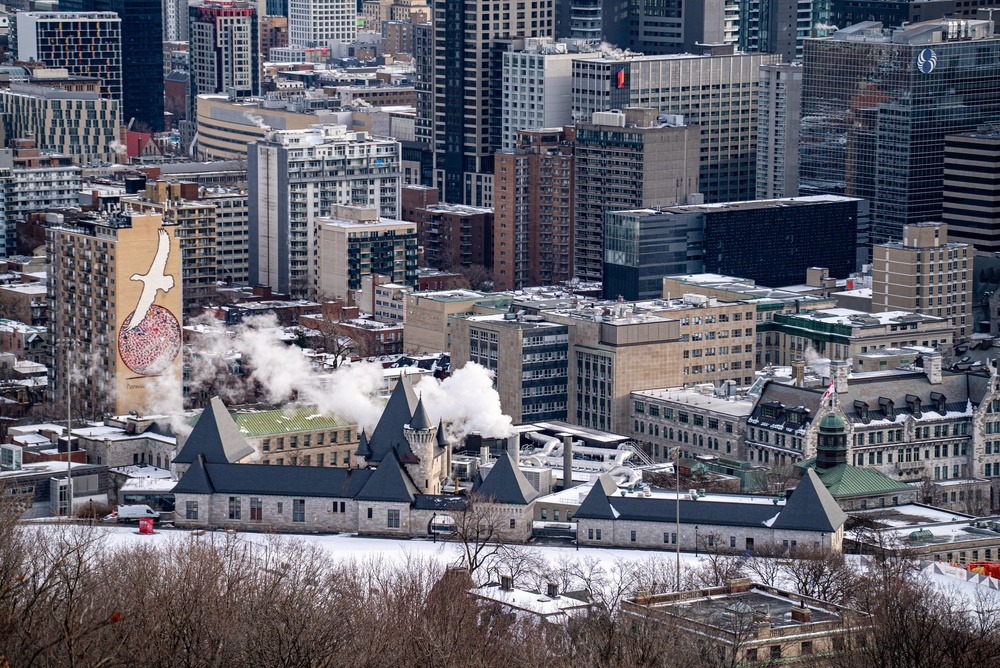
The Kondiaronk viewpoint offers one of the most direct views of Montreal's skyline and the Saint Lawrence River. The adjoining chalet houses an interpretation centre dedicated to the mountain's history as well as permanent artworks, including murals depicting the history of New France.
Saint-Joseph Oratory
Founded in the early 20th century by Brother André on the western slopes of Mount Royal, Saint-Joseph Oratory stands out for the monumentality of its architecture and its dome visible from afar. The site combines religious architecture, history and an open panorama over the western part of the city.
Mount-Royal Cemetery
Laid out as a landscaped park, Mount-Royal Cemetery can be explored away from the main trails. Its tree-lined paths and historic monuments offer a subtle reading of Montreal's history, in a quieter atmosphere than the rest of the park.
Beaver Lake
A body of water nestled in the heart of the park, Beaver Lake takes on different characteristics depending on the season:
- in summer, strolls around the water's edge and lawns frequented on weekends,
- in winter, an open-air skating rink beloved by families.
The adjacent pavilion allows you to extend your break near the lake.
Urban biodiversity
With its three summits and territory of roughly 10 km², Mount Royal is home to more than 700 species of vascular plants, some of them rare, as well as a mature forest that structures the landscape. In terms of wildlife, nearly 20 mammal species, two amphibian species, two reptile species and over 180 bird species are recorded: grey and red squirrels, raccoons, red foxes and bats can be observed regularly.
When to visit Mount Royal
The mountain can be explored year-round. Summer (June to August) is ideal for hiking, picnicking and enjoying clear views. Fall (September-October) is appreciated for the colors of maple foliage. Winter (December to March) opens the Beaver Lake skating rink and cross-country skiing and snowshoeing trails. Spring marks the gradual return of vegetation and visitor activity. Weekday late afternoons remain the calmest times to enjoy the viewpoints.
Practical information
Mount Royal designates the entire massif, while Mount-Royal Park corresponds to its developed and visitable portion, where the main trails, viewpoints and sites to discover are concentrated. Access to the park is free and open. Allow 2 to 4 hours for a visit combining a viewpoint, Beaver Lake and a wooded trail; a full day if you add Saint-Joseph Oratory and the cemetery.
- Wear appropriate footwear: some trails have sections of earth or stairs.
- Water and restrooms are available mainly around the chalet and Beaver Lake.
- Olmsted Path is reserved for pedestrians and cyclists.
- Vehicle access is not permitted to Mount-Royal Chalet.
How to get there
Several access points allow you to reach the park from Montreal:
- On foot or by bike from downtown, Plateau-Mont-Royal or Côte-des-Neiges, using entrances from Peel Street, Parc Avenue or Camillien-Houde Way.
- By public transit, via metro and several bus lines serving the park's edges.
- By car, using the paid parking at Smith House or Beaver Lake. A short walk is then needed to reach the viewpoints.
Nearby
Mount Royal fits easily into a stay in Montreal, of which it is one of the major landmarks. To extend your exploration of Quebec, Château Frontenac in Quebec City and Île aux Coudres in Charlevoix offer two complementary stops. On the Ontario side, Toronto's CN Tower is another urban symbol worth comparing with the Kondiaronk viewpoint.
Frequently asked questions
Frequently asked questions
Yes. Access to Mount-Royal Park and its trails is free and open year-round. Only the parking at Smith House and Beaver Lake incur fees.
Allow 2 to 4 hours for a loop including a viewpoint and Beaver Lake. A full day allows you to add Saint-Joseph Oratory and Mount-Royal Cemetery.
No. Vehicle access is not permitted to Mount-Royal Chalet. Drivers park at Smith House or Beaver Lake and complete the journey on foot via Olmsted Path, which is reserved for pedestrians and cyclists.
Summer for views and hiking, fall for maple foliage colors, winter for skating at Beaver Lake and cross-country skiing. Each season highlights a different use of the park.
Yes. The areas around Beaver Lake and Olmsted Path are suitable for strollers and young children, while trails leading to the cross require better physical fitness.
Plan your trip
To integrate Mount Royal into a broader itinerary, consult our Canada travel guide and our suggestions for circuits combining Montreal, Quebec City and the landscapes of the Saint Lawrence.
Interested in this visit?
We can include it in your personalised itinerary.