Gros-Morne National Park
Gros-Morne National Park
On Newfoundland's west coast, Gros-Morne National Park combines fjords, geological Tablelands, and coastal villages. UNESCO World Heritage Site since 1987.
On Newfoundland's west coast, Gros-Morne National Park spans nearly 1,800 km² of mountains, fjords, and Atlantic coastline. Inscribed as a UNESCO World Heritage Site in 1987, it is one of the rare places on earth where the Earth's mantle surfaces naturally, making it a reference site for geology. The seaside village of Rocky Harbour serves as the main base for visitors.
Why Visit Gros-Morne National Park
The park combines three rare assets in one territory: geology of global significance (the Tablelands, Green Point), spectacular inland fjords such as Western Brook Pond, and accessible northern wildlife (moose, caribou, whales offshore). Add to this a network of small coastal villages—Rocky Harbour, Woody Point, Norris Point, Cow Head—that maintain active cultural and artistic life. It is a park where you can alternate between demanding hikes, fjord cruises, and evenings in local cafés or theatres.
History and Heritage
The region has been inhabited for over 5,000 years. Indigenous peoples, including the Maritime Archaic and later the Mi'kmaq and Beothuk, occupied this coastline long before the arrival of Vikings, Basque and Breton fishermen, and then French and British settlers. The coastal villages long relied on cod fishing and timber harvesting.
The park was created in the 1970s under a federal-provincial agreement, then designated a UNESCO World Heritage Site in 1987 for its geological formations. It was officially established as a national park in 2005, following the provincial legislative process. Today, environmental management and the presence of communities within the park coexist.
What to See and Do
The Tablelands
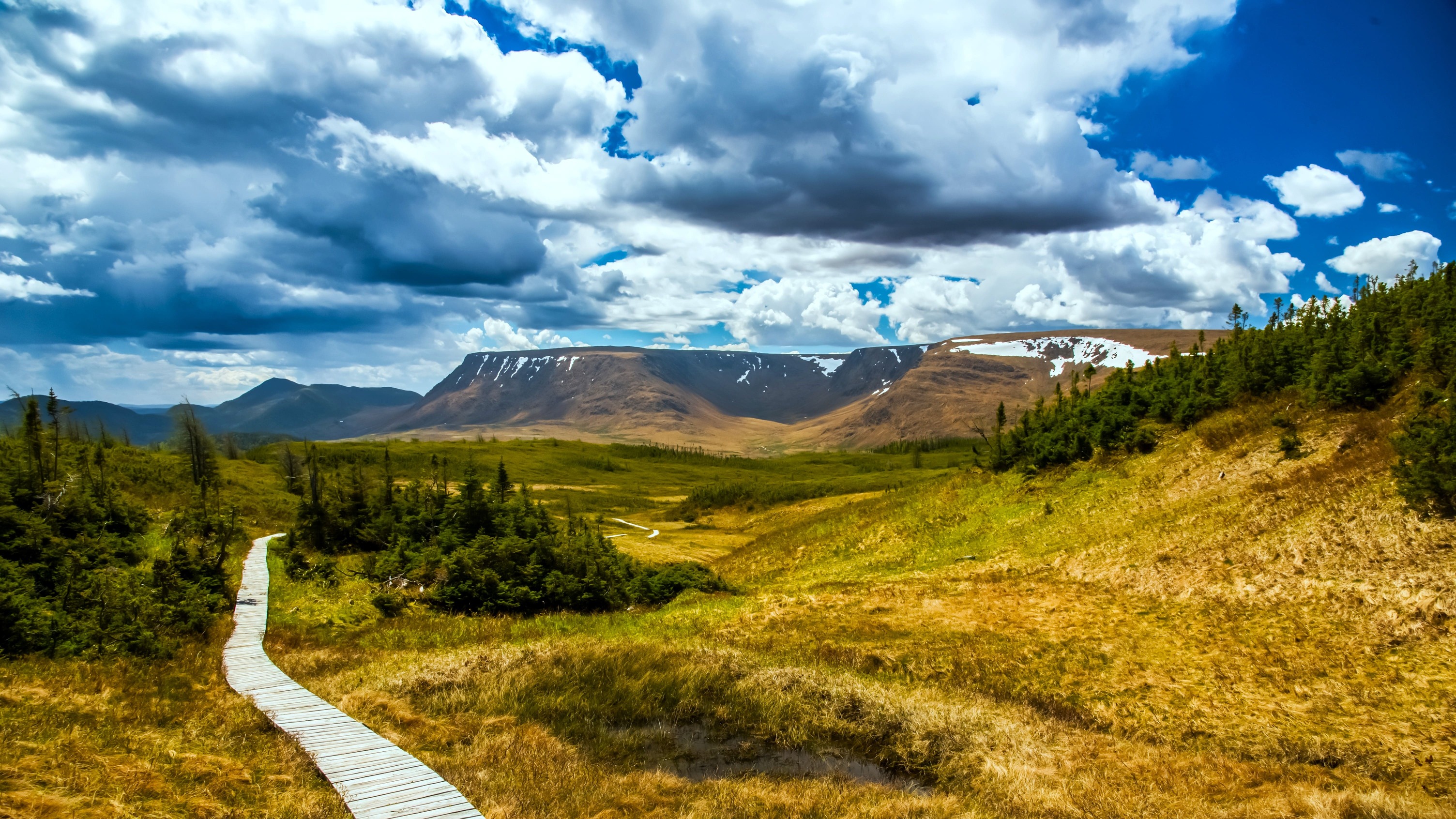
An ochre plateau of peridotite rock from the Earth's mantle, it is the park's geological signature. The Tablelands hike, roughly 4 km round-trip, is accessible to most walkers and is often done with a park interpreter-guide, who places this landscape within plate tectonics theory.
The Western Brook Pond Fjord
A former glacial fjord now a freshwater lake, framed by 650-metre cliffs. Access is via a 3 km walk on boardwalks, then by excursion boat. This is one of the park's most sought-after activities: advance booking is recommended during peak season.
Climbing Gros-Morne Mountain
The summit reaches 806 metres and offers views of the Long Range mountains and Ten Mile Pond gorges. The full loop takes a full day (roughly 16 km, demanding elevation gain) and is only open in summer, once the tundra zone is clear.
Green Point
A world-renowned geological reference site, recognized as the stratotype for the boundary between the Cambrian and Ordovician periods. At low tide, the tilted rock strata are directly visible on the beach.
Lobster Cove Head Lighthouse
Near Rocky Harbour, this lighthouse houses an exhibition on the life of fishermen and the human history of the coast. The site is quick to visit and easily fits into a half-day in the park's northern sector.
Cultural Life in the Villages
Woody Point and Cow Head host theatre, literature, and music festivals each summer. Norris Point and Rocky Harbour concentrate restaurants, accommodations, and services.
When to Visit
The main season runs from mid-May to mid-October, during which visitor centres, Western Brook Pond cruises, and most trails are operational. July and August offer the mildest temperatures (15–22 °C daytime) but also the heaviest crowds. June and September are good compromises: fewer visitors, active wildlife, but less stable weather.
Winter transforms the park into cross-country skiing and snowshoeing terrain; most services close, except the Green Point campground, which is open year-round. The fjords may remain partially frozen until May, which delays the start of cruises.
How to Get There
- By Air: Deer Lake Airport (YDF), 35 km from the park, is connected to Montreal, Toronto, Halifax, and St. John's. Car rental available on-site.
- By Ferry: Marine Atlantique operates the North Sydney (Nova Scotia) – Port aux Basques crossing year-round (roughly 6 hours), then 4 hours by road to the park. A seasonal link also connects Argentia, operating roughly mid-June to September.
- By Bus: The DRL line connects St. John's to Port aux Basques and stops near the park; local shuttles and taxis complete the journey to Rocky Harbour, Woody Point, or Norris Point.
Practical Information
- Opening Period: Park accessible year-round; main services from mid-May to mid-October.
- Admission: Modest per-adult park entrance fee, free for youth; family rates available. Check current prices on the Parks Canada website.
- Accommodation: Park campgrounds (Green Point open year-round), guesthouses and inns in coastal villages, a few lodges. Booking recommended in July-August.
- Equipment: Hiking boots, windproof jacket and warm layers even in summer; conditions change quickly at altitude.
Nearby
The park centres on four key villages: Rocky Harbour (central hub, services), Norris Point (views over Bonne Bay), Woody Point (Victorian architecture, festivals), and Cow Head (further north, summer theatre). Beyond, the Northern Peninsula leads to the Viking site of L'Anse aux Meadows. To compare with other Canada national parks, you can extend to Forillon National Park in the Gaspé or, at the other end of the country, to Banff in the Rockies.
Frequently Asked Questions
Frequently asked questions
Three to four days allow you to combine the Tablelands, a cruise on Western Brook Pond, the Rocky Harbour sector, and a summit or coastal trail. A week is ideal for including summer festivals and neighbouring villages.
Late June through early September for all services to be open, stable hiking conditions, and Western Brook Pond cruises in operation. September offers quieter crowds.
It is possible but limited. The DRL line and local shuttles serve the main villages, but most trails and access points require a vehicle. Renting a car at Deer Lake is the most practical option.
Yes, excursions depart from Norris Point or Rocky Harbour, mainly from June to August. Seals and whales (fin whales, minke whales) are regularly spotted offshore.
The Western Brook Pond cruise and accommodations in July-August are booked several weeks ahead. Hiking trails are free-access and do not require booking, though some require check-in at the visitor centre.
Plan Your Trip
Gros-Morne fits naturally into a larger itinerary across the Atlantic provinces or to the Northern Peninsula. To build a custom stay combining Newfoundland, Gaspé, and cultural cities, explore our Canada trips.
Interested in this visit?
We can include it in your personalised itinerary.