Kootenay National Park
Kootenay National Park
UNESCO-listed, Kootenay National Park traverses the Canadian Rockies between Castle Junction and Radium Hot Springs: canyons, paint pots and thermal basins.
Located in southeastern British Columbia, Kootenay National Park forms, together with Banff, Jasper and Yoho, the heart of the Canadian Rockies inscribed on the World Heritage list. Less visited than its neighbours, it stretches nearly 100 kilometres featuring sculpted canyons, ochre soils, emerald cascades and thermal basins, along Highway 93 South connecting Castle Junction to Radium Hot Springs.
Why visit Kootenay National Park
Kootenay brings together in a single scenic drive most of the emblematic landscapes of the Rockies: subalpine forests, turquoise-hued rivers, limestone walls, alpine meadows and geothermal springs. Its visitor numbers remain moderate compared to Banff or Lake Louise, making panoramic stops and short trails more accessible, even during peak season. The park suits both a day's transit and a multi-day stay combining hiking, thermal bathing and wildlife watching.
History and heritage
Creation and infrastructure
Kootenay National Park was established in 1920 as part of an agreement between the Canadian federal government and the province of British Columbia. Its creation accompanied the construction of the Banff–Windermere Road (Highway 93 South), which opened access for the first time to the region's isolated valleys and remains today the main visiting route.
Indigenous presence
The territory has been frequented since the end of the last glaciation. The Ktunaxa Indigenous peoples knew of the thermal springs and used them for practical and ritual purposes. They also practised controlled burning to promote vegetation regeneration and game grazing — a practice Parks Canada is progressively reintegrating into territory management.
World Heritage and wildfires
In 1984, Kootenay joined the network of Canadian Rocky Mountain parks inscribed on UNESCO's World Heritage list, alongside Banff, Jasper and Yoho. The major forest fire of 2003 reconfigured certain sections of the Vermilion Valley, where charred trunks and forest regeneration are today visible from the road and several trails.
What to see and do
Marble Canyon
A narrow limestone gorge carved by Tokumm Creek, Marble Canyon is explored via a short trail dotted with catwalks overlooking successive waterfalls. The circuit remains family-friendly and allows observation of erosion work on the canyon walls.
Paint Pots
This mineralized zone features iron-saturated soils in ochre and red hues. The pigment was long harvested by Indigenous peoples, who used it for body painting, pictographs and trade. A short trail crosses the Vermilion River before reaching the basins.
Numa Falls and viewpoints
Numa Falls, on the Vermilion River, are visible from a bridge minutes from the parking lot. Further south, Kootenay Valley Viewpoint offers a comprehensive view of the Mitchell and Vermilion ranges.
Radium Hot Springs
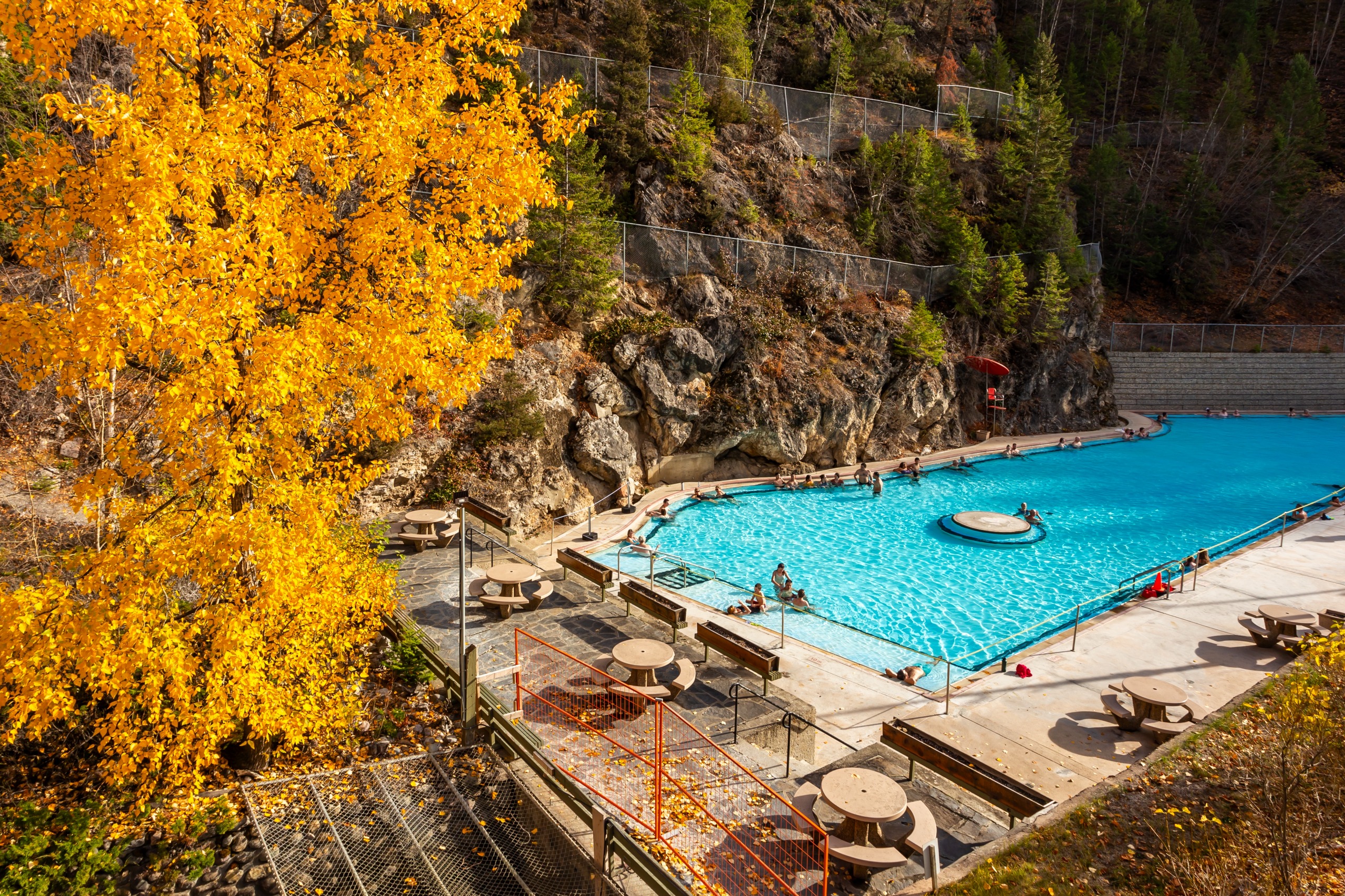
At the park's southern edge, Radium Hot Springs features two basins fed by naturally mineral-rich geothermal waters. It is one of the park's most visited stops, particularly prized after a day of hiking.
Hiking and wildlife
The trail network covers all levels, from valley-floor walks (Dog Lake, Olive Lake) to high-altitude routes leading to alpine passes and lakes. Wildlife includes grizzly bears, moose, wolves, bighorn sheep, lynx and Steller's jays. Observation takes place at regulated distance, ideally early morning or late afternoon.
When to visit
- Summer (June–August): long days, high-altitude trails clear, campgrounds open, increased visitor numbers around the hot springs.
- Autumn (Sept.–Oct.): moderate temperatures, larch colours at elevation, reduced visitor numbers.
- Winter (Nov.–March): Highway 93 South open but demanding conditions, snowshoeing and cross-country skiing in certain areas, hot springs open.
- Spring (April–May): low-altitude trails accessible, active wildlife, some secondary roads still closed.
Practical information
A Parks Canada pass is mandatory to travel within the park and must be displayed visibly in your vehicle. Two options are available: the daily pass for a single visit, and the Discovery Pass valid annually at most Canadian national parks and advantageous from two or three visits per year. Rates are updated annually on the Parks Canada website.
In grizzly and black bear territory, carrying bear spray on trails is recommended, as is strict compliance with food storage guidelines.
Getting there
The park is traversed north to south by Highway 93 South, between Castle Junction (on the Trans-Canada Highway in Banff National Park) and Radium Hot Springs. From Calgary, allow approximately 2.5 to 3 hours driving via Highway 1 to Castle Junction, then Highway 93 South. The road remains open year-round, but winter conditions require appropriate tires and caution. No regular public transportation serves the park: a personal or rental vehicle is the only practical option.
Nearby attractions
Kootenay combines easily with the other UNESCO-listed Rocky Mountain parks. Banff National Park, immediately to the northeast, shares the park boundary at Castle Junction and concentrates most accommodation and services. To extend your exploration of Canada's wild spaces, Gros Morne National Park in Newfoundland, Forillon National Park in the Gaspé Peninsula or Bic National Park in Quebec offer other facets of the country's protected landscapes.
Frequently asked questions
Frequently asked questions
Yes. Any vehicle stopping in the park must display a valid Parks Canada pass, whether a daily pass or the annual Discovery Pass. It can be purchased online, at park entrances or at certain visitor centres.
Late June to mid-September for high-altitude hiking and full services. September and early October offer a good balance of stable conditions, autumn colours and lower visitor numbers. Winter is best suited for Radium's thermal basins and snowshoeing.
The park is home to grizzly and black bears. Encounters remain rare but possible on trails. It is recommended to hike in groups, make noise, keep bear spray accessible and follow posted guidelines on food and waste management.
Planning your trip
To include Kootenay National Park in an itinerary through the Rockies or a grand tour of western Canada, explore our Canada trips and bespoke suggestions.

Interested in this visit?
We can include it in your personalised itinerary.