Bonaventure Island and Percé Rock
Bonaventure Island and Percé Rock
Facing Percé, Bonaventure Island hosts the world's largest Northern Gannet colony and 15 km of trails between cliffs and island heritage sites.
Just kilometers off the Gaspésie coast, Bonaventure Island rises in the Gulf of Saint Lawrence opposite Percé Rock. Sheer cliffs, forest trails and seabird colonies make up a protected site since 1919, now integrated into Bonaventure Island and Percé Rock National Park. Access is by boat only, from Percé's wharf, during the summer season.
Why visit Bonaventure Island
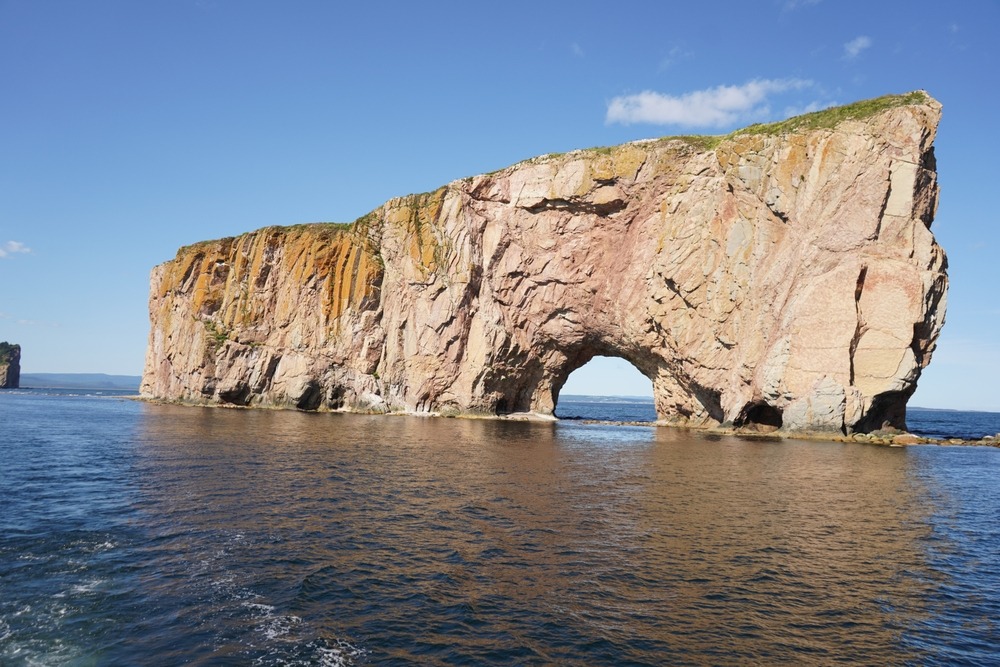
The island is home to the world's largest Northern Gannet colony, with over 100,000 individuals gathered on its southern cliffs. Nearly 300 bird species have been recorded there, making it one of North America's leading ornithological sites. Beyond wildlife, you'll find 15 km of trails, panoramic views over the gulf and remnants of island life that ended in 1971. The crossing passes by Percé Rock, a pierced limestone monolith with an arch, another signature of the Gaspésie landscape.
History of Bonaventure Island
From the 17th century, the island served as a seasonal fishing port, notably exploited by the family of Nicolas Denys, a prominent figure in New France. During the 18th and 19th centuries, settlers from Europe and Ireland established themselves permanently to exploit cod, founding small hamlets whose traces still remain visible.
In 1919, the island was classified as a sanctuary for migratory birds, a pioneering status in Canada. In 1971, the Quebec government acquired it and proceeded with the expropriation of the last island families, an operation that remains a sensitive episode in local history. Since 1985, the island and Percé Rock have formed a national park managed by Sépaq. The former Canadian aircraft carrier HMCS Bonaventure, in service from 1957 to 1970, bore the site's name.
What to see and do on the island
The Northern Gannet colony
The Colonies Trail leads directly to the cliffs where Northern Gannets nest. Viewpoints allow you to observe them just meters away: courtship displays, flights to and from the sea, returns to the nest. The best observation period runs from June through late August, when the colony is most active. Other species nest on the cliffs: Black Guillemot, Double-crested Cormorant, Atlantic Puffin.
The hiking trails
The island is crossed by approximately 15 km of marked trails, with main routes connecting the landing area to the southern cliffs. The itineraries are accessible to most visitors, with moderate elevation changes. Allow 3 to 5 hours for a complete loop including bird watching.
Built heritage
The Le Boutillier House, a former Norman-English fishing post, testifies to 19th-century economic organization. Further on, the remnants of villages expropriated in 1971—foundations, fences, orchards returned to the wild—form a memorial walk along the trails.
Le Chafaud Discovery Centre
Before or after the crossing, the Le Chafaud Centre, located on Percé's wharf, presents the human and natural history of the site through exhibitions and interpretive activities.
Practical information
- Access: by boat only, from Percé's wharf.
- Crossing time: 30 to 45 minutes, passing around Percé Rock.
- Opening season: June to October.
- Admission fees: the boat ticket does not cover park entry fees, payable separately at Sépaq.
- Equipment: hiking shoes, windbreaker, water and picnic (limited services on the island).
When to visit
The main season runs from June to October. July and August offer the mildest temperatures and peak activity of the Northern Gannet colony, but also the heaviest crowds. June and September offer a good balance: favorable weather, fewer visitors, and sustained ornithological activity through late August. In October, the season winds down and departures become less frequent.
How to get there
Departures take place from Percé's wharf, in the heart of the village. Two main companies operate the crossings:
- Croisières Julien Cloutier
- Les Bateliers de Percé
Rotations are frequent in high season (July-August), with several departures per day. It is advisable to book in advance during peak season. Most packages include a tour around Percé Rock before landing on the island.
Nearby attractions
The village of Percé deserves a stop for its waterfront, galleries and Mont Sainte-Anne overlooking it. Further north, Forillon National Park extends the Gaspésie peninsula with its cliffs, seals and coastal trails. Moving upriver toward the estuary, Bic National Park offers a jagged coastline ideal for observing marine wildlife.
Frequently asked questions
Frequently asked questions
No. Access season runs from June to October, depending on navigation conditions. Outside this period, no regular maritime service is available.
Plan for a half-day to a full day: 30 to 45 minutes for the crossing each way, and 3 to 5 hours on the island to explore the trails and observe the birds.
No. Park admission fees for Bonaventure Island and Percé Rock National Park are paid separately at the Sépaq ticket window on the wharf.
From June through late August, during nesting and chick-rearing. The colony then counts over 100,000 individuals, observable from just a short distance at the designated viewpoints.
Yes. The main trails feature moderate elevation changes and remain accessible to casual walkers. Still plan for closed-toe shoes and water, as no supplies are guaranteed on the island.
Extend your stay in Gaspésie
Bonaventure Island is part of a larger itinerary around the Gaspésie peninsula and the Saint Lawrence. To plan a trip combining Percé, Forillon and other Quebec national parks, see our suggestions on travel in Canada.
Interested in this visit?
We can include it in your personalised itinerary.