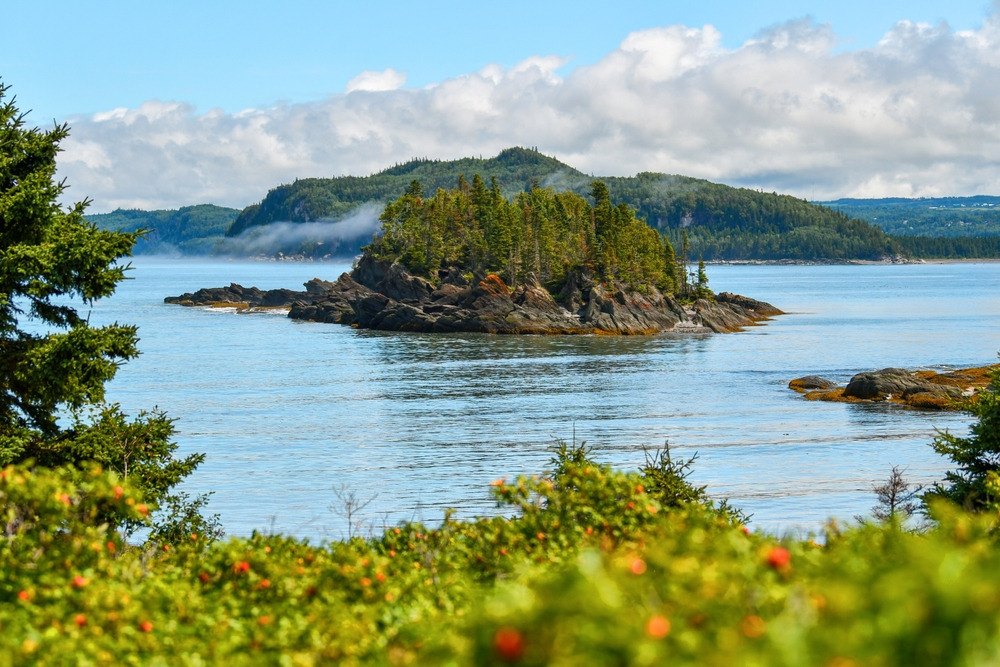
Pointe-Taillon National Park
Pointe-Taillon National Park
On Lake Saint-Jean, Pointe-Taillon National Park stretches across 15 km of beaches, 45 km of cycling trails and rich wildlife, 30 km northwest of Alma.
Pointe-Taillon National Park unfolds along the northern shore of Lake Saint-Jean, in the Saguenay–Lac-Saint-Jean region, roughly thirty kilometers northwest of Alma. It combines 15 km of fine sand beaches, a forest in transition between boreal and temperate ecosystems, and some thirty islands scattered across the lake. Its low-lying peninsula configuration makes it one of Quebec's rare parks where swimming in relatively warm waters meets bird watching and long-distance cycling.
Why visit the park
The park stands out for three characteristics rarely found together in Quebec. First, its beaches: 15 km of fine sand containing garnets, zircon and magnetite, giving certain areas a distinctive dark shimmer. Second, its 45 km cycling network, of which 16 km are integrated into the Route verte, crossing forests, wetlands and lakeshores with virtually no elevation change. Third, its biodiversity: approximately 200 bird species recorded, including sandhill cranes, Bonaparte's gulls and common terns, along with a stable population of moose and beavers.
Forest covers more than 40% of the territory and marks an ecological transition zone: you'll encounter both boreal species and deciduous trees typical of more southern latitudes. This mosaic explains the avian richness and frequency of wildlife sightings.
Territory history
Before becoming a park, Pointe-Taillon was farmland, an inhabited village, then a partially submerged zone. This layering of eras gives the place a depth that the current landscape barely suggests.
Originally known as pointe Savane, the peninsula takes its current name from Louis-Olivier Taillon, Prime Minister of Quebec for four days in 1886, then from 1892 to 1896. Between 1890 and 1930, its lands were progressively devoted to agriculture. The municipality of Jeanne-d'Arc was established in 1916, and the point reached its demographic peak in 1925 with 307 residents.
Bouliane Island, owned by Frenchman Paul-Augustin Normand, operated as a major agricultural enterprise employing over 125 workers. Everything changed in 1926: the closure of the Isle-Maligne hydroelectric facility's water gates led to the submersion of the peninsula's most fertile lands. Alcan subsequently acquired the parcels and conducted reforestation between 1948 and 1956. The government reclaimed the territory in 1977, and the park was officially opened on November 6, 1985. In January 2017, its area expanded from 92.2 km² to 97.5 km², incorporating lands from Saint-Henri-de-Taillon, Saint-Gédéon and Alma, as well as some thirty islands and islets.
What to see and do
Beaches and swimming
The 15 km of beaches are the main attraction during warm season. Swimming is supervised near the Discovery and Services Centre in the Taillon sector. The sand, rich in garnets, zircon and magnetite, displays distinctive dark shimmer in places.
Cycling and water activities
The 45 km cycling network traverses the entire peninsula, with 16 km integrated into the Route verte. Kayak, canoe and pedalo rentals are available on-site. Accessible islands allow for day exploration or camping expeditions.
Wildlife and observation
Moose frequent the park's wetland zones regularly, and beavers are particularly abundant here, their construction activity helping maintain regenerating open areas. For birdwatching, the Camp-de-Touage-Les-îles sector is renowned for species diversity. Guided excursions led by park wardens are offered seasonally.
Discovery activities at the Centre
- Return to Jeanne-d'Arc: traces the history of the former village that bordered Taillon point from 1916 onwards.
- Beneath the waves of Pekuakami: presentation of Lake Saint-Jean's aquatic species.
Winter
With the first snows, the park transforms into another realm: boreal forest, snow-covered beaches and a frozen lake. The trails suit snowshoeing, fatbiking and winter hiking.
When to visit
The summer season, from late June through late August, concentrates most offerings: swimming, cycling, kayaking, camping. Lake Saint-Jean waters reach temperatures suitable for swimming. September offers calmer conditions with fall colors, though supervised swimming ends. The winter season, December through March, is devoted to snow and ice activities, with low visitor numbers.
Accommodation and services
- Three campgrounds along the lakefront in different sectors
- One rustic site accessible only by water, for paddlers
- Huttopia glamping tents and rental chalets
- Snack bar, terrace, parking and sanitary facilities adapted for people with reduced mobility
- Level 2 charging stations in all three sectors
How to get there
The park is accessed via Route 169, which encircles Lake Saint-Jean. Three distinct entry points serve its different sectors.
From Quebec City
- Take Route 175 North toward Saguenay for approximately 100 km
- Reach Route 169 and follow signs toward your chosen sector
Access points
- Pointe-Taillon sector: 835, rang 3 ouest, Saint-Henri-de-Taillon
- Les-Amicaux sector: 95, chemin Belley
- Camp-de-Touage-Les-îles sector: 450, chemin du Golf, Saint-Gédéon
No public transit lines serve the park directly; the nearest terminal is in Alma, roughly 25 km from the Pointe-Taillon sector. A personal vehicle or rental service from Alma or Saguenay is necessary to access the entrances.
Nearby attractions
To extend an itinerary devoted to Quebec and Atlantic Canada's national parks, several sites allow you to vary the landscapes:
- Bic National Park: rocky headlands and carved bays along the St. Lawrence, in the Lower Saint-Lawrence region.
- Forillon National Park: the tip of the Gaspé Peninsula, cliffs and marine observation.
- Battlefields Park: vast historic urban space in the heart of Quebec City.
- Gros-Morne National Park: UNESCO-listed reliefs and fjords in Newfoundland.
Frequently asked questions
Frequently asked questions
Summer, from late June through late August, remains the most comprehensive period: supervised swimming, cycling, kayaking and camping are all accessible. September suits cycling and hiking in calmer conditions. Winter, December through March, is ideal for snowshoeing and fatbiking, with low visitor numbers.
Yes. The park features 15 km of fine sand beaches, and swimming is supervised near the Discovery Centre in the Taillon sector during high season. Lake Saint-Jean waters reach temperatures suitable for swimming in July and August.
No, not directly. The nearest terminal is in Alma, roughly 25 km from the Pointe-Taillon sector, with no regular service to Saint-Henri-de-Taillon. A personal vehicle or rental service from Alma or Saguenay is necessary.
Plan your trip
Pointe-Taillon National Park fits naturally into an itinerary in the Saguenay–Lac-Saint-Jean region, to combine with the Saguenay Fjord, Tadoussac or the Route des parcs québécois. To build your circuit, consult our Canada trips.
Interested in this visit?
We can include it in your personalised itinerary.